Showing posts with label Bawarchi. Show all posts

Saturday, March 17, 2018

Birpara : 'Bride and Prejudice'

Ghenwa the Jewel: A Birpara Story

One of the tough examinations I've had to pass in life was the test set by the bungalow servants in my first tea bungalow.
Ghenwa was cook cum head honcho of the world beyond the dining room. He looked like some kind of tribal Amitabh Bachchan: tall, thin, arrogant and unsmiling. He was a handsome man, with thick wavy hair, large brown eyes and lips that could smile when they weren't being curled. He couldn't have been much older than me, but he filled me with nervous fear. 

I, who had quelled classrooms of undergraduate students not four years my junior with one look just weeks before my marriage!

Mohan had been in the Engineers' Bungalow in Birpara for about a year before we got married. Ghenwa was a trusted aide. Mohan left the running of the bungalow to him, and Ghenwa served him with devotion; in fact he quite doted on him. He felt let-down when Mohan produced a bride at the end of one 'chhutti'. From Ghenwa's point of view - I see it now - it meant the end of independence, and a reduction in stature.
Mohan didn't want me to bother with the kitchen for the first few days. I was grateful only because I was too chicken to enter Ghenwa's domain. The bearer Joseph was a cute, smiling chap, quite cowed by Ghenwa, like me. He became an ally. He'd serve our breakfast in smiling silence while Ghenwa, after finishing up the cooking and delegating toast making to some unseen hands, would enter the dining room in state and take up his position at Mohan's right hand. He would stand there and declaim - a sort of daily round-up or news bulletin - in what was a strange lingo to me, and Mohan would reply in the same lingo. If Ghenwa wanted to make me feel left out, he succeeded. This colloquy would continue until Mohan asked him in Hindi what he was going to serve Memsaab for lunch. 

The first time I ventured into Ghenwa's store and pantry, I made a hesitant suggestion about the food. He gave me the full Amitabh Bachchan stare, and said by all means, I was free to issue any commands, but he could not guarantee that his saheb would like what I suggested. I fled.
I was the encroacher in his little kingdom, and I was too ashamed to tell my new husband how inadequate Ghenwa made me feel. His hafta chutti was probably the happiest day of my week. 
Once this tyrant went home at night, the chowkidaar took over as my chief tormentor. Etowah - that was his name -stole everything that wasn't nailed to the floor. Mohan told me how he'd served him tea one chilly morning wearing his - Mohan's - socks. When Mohan bellowed at him, Etowah swore those were the socks that a departing Chhota Saab had presented him many years ago. 
Another time, Mohan surprised him when he had his head in the fridge and several fingers in a bowl of custard! Etowah could also make sugar and milk disappear from bowls without a trace.
I was wretched. What kind of administrator was I, who couldn't even keep house for two without losing potatoes, onions, oil, milk and sugar by the kilo?
Life wasn't all housekeeping, though, and we had a lot of fun. Also, there were others like me, new to tea and with similar tales of woe. We all met regularly at the club or at one another's bungalows. 
There was a tradition of people coming in from the club in the wee hours to torment newly-weds in the district. We had our turn too. It must have been two thirty in the morning, when we woke to the sound of several cars honking outside our gate. We could hear voices yelling, 'Open up! Once the crowd of merry makers was in the bungalow, there was much leg-pulling and ribald laughter, and it was impossible to feel anything but happy. Everyone clamoured for coffee. Of course, coffee! That was the reason they'd all 'dropped in' barely two hours after we'd said goodnight, for an early morning cup of coffee!
I wasn't embarrassed when they'd all pounded on our bedroom door and asked how much time we needed to dress, but now, I was red in the face. By now, I thought, Etowa would have drunk every last drop of milk, copiously sweetened with every grain of sugar in the bungalow. Still, I rang the bell and weakly asked him to bring coffee. Everyone around me continued to shout with laughter and have a good time while I sat and waited for the ground to open and swallow me up. What was Etowa going to serve ? There must have been a dozen people there!
The door swung open and in he sailed, with my best (wedding present) cups on a tray, each filled to the brim with frothy and fragrant coffee. The sugar bowl was full, too. My nightmare was suddenly magicked into a happy dream! Today the man had changed his act: he was making things appear and not vanish!
Some months passed, with one or two more riotous night time invasions. These were no 'intrusions of privacy'. We didn't know what privacy was in those days, and I don't think we'd have cared much for it. What we had instead was community - a family that pulled you into its fold - in a world far away from home. If loss of privacy was the price we paid to belong, we were happy to pay in those days!! 
     'Family' Picnic

Ghenwa continued to dazzle and hold sway, and he must have been satisfied with my state of surrender. I had a brand new mixi and he had skill, and we'd started calling people over to eat. On one Sunday, we asked one of Mohan's oldest bachelor friends to breakfast. He'd - let's just call him B - he'd left Lankapara early in the morning and run into a colleague - T -in Birpara town. When he heard where B was headed, T called him a lucky man and said he felt like eating dosas too, so would he tell Mohan and Gowri that he'd be along soon with whoever was at the club?

 That was B's style. Our club – well, all our tea clubs - were filled with eccentrics, both men and women. I could just visualise T going in to Dalgaon club and standing at the entrance, announcing, 'Everyone's invited to Mohan and Gowri's bungalow for dosas! Chalo!!!' When B told us about this, my jaw dropped in horror. I could provide dosas, chutney, sambar et al for another couple of people, say three more at the outside, but the early morning tennis crowd from Dalgaon Club?? What kind of disastrous life had I let myself in for when I married this happy-go-lucky moustachioed man? 

The man turned out to be as big a crack-pot as any of his nutty friends. He laughed!! He summoned Ghenwa and told him to expect another dozen people and said, 'Tum pugaa do; sab ko khilayega!' (stretch your resources, feed everyone). He looked at me and said, 'Relax! Our man will manage!' What blind faith, I thought.

Ghenwa piped in, 'Hum pugai dega, Memsaab! Aap log pehle kha lega!' ( I will manage! you should all eat first!') at which Mohan and friend B, the invited guest, expressed complete agreement. 

By this time, Burra Sa'ab's jeep had rolled in, and Jusep Driver had unloaded a case of beer. Burra Sa'ab and Mem saab would be along soon, he said, but they wanted us to chill the beer. I was fretting about place settings at the table but the two mad men in my bungalow urged me to eat quickly, and I remember I did eat, even though it choked me to think of what would happen when the crowds arrived.

It was Ghenwa's show all the way. In great good humour, he even treated me with kindness, bringing me my coffee himself with an air of deference. I was in shock, I think. 

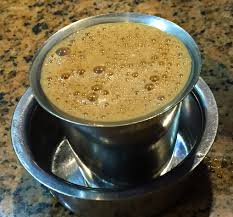
The crowds came. Burra Sa'ab and Mem Sa'ab, a few friends, some tennis players I knew only by sight and of course the villainous T. Ghenwa fed them all until they swore they'd had enough. 'Excellent!' 'Brilliant!' 'Genuine South Indian taste!' was what I kept hearing. The ladies wanted their coffee in what they called 'those little south Indian glasses and katories'. They got what they wanted. 

After coffee, beer flowed. Burra Sa'ab and Mem were full of praise and thanks for a wonderful morning. 

Ghenwa had ensured that I didn't enter the kitchen, and I honestly have no idea, to this day, how he managed that show.   
Image result for coffee davara tumbler 

Saturday, May 29, 2010

The Fruits of Labour!


These plums are the fruits of labour. Pick them, and you are committing yourself to some hard labour!

The plum tree in the compound didn't fruit at all last year because of the terrible drought. It was a loss - there was no plum jelly on the table.

This year the tree has put out its best. You'd hardly think this little guy was up to it, looking at the size and shape. It's in a dark corner of the garden, leaning on the garage wall.


The first time the tree fruited, we thought we could eat the plums as they were. They were small, but looked rich and luscious. One bite was enough to put us off. They werent just sour, they were bitter.

Those days the old Bawarchi (cook) Lakshman Singh Pradhan - but we never called him that; he liked the title Bawarchi - was alive. He was the last of the old-timers: a man who could cook several kinds of cuisine and could bake beautifully as well. I asked Bawarchi if we could make jam with the plums since they were so sour, and he said it wouldn't be possible.

Before I could argue, he said we could make jelly but not jam. I realised that he was a man of superior knowledge. He explained that he would stew the fruit whole, then strain the liquid into a cloth bag and collect the slow drippings. He would then take an equal weight of sugar, and boil it with the liquid till it reached setting point. So our first batch of plum jelly - not jam - was made by Bawarchi himself.


Boiling the fruit


In the bag. Govind is securing newspaper around it to keep the ever present 'poka'(insects) away.

In spite of the sweltering weather, we've been pickling and preserving fruits as if they're going out of fashion.


From left: Plum Jelly, Sweet Lime(Mausammi) Marmalade, Marwari Mango Pickle, Avakkai Mango Pickle.

Monday, October 20, 2008

Brownie Points!


Gone are the days when every Burra Bungalow in tea had a cook who would bake all the bread its occupants needed. Even so, we had dear old Baruah baking all our bread for us less than fifteen years ago. Baruah and his contemporaries are no more, but I do know of some chai memsaabs who turn out very good bread at parties or club 'do's. I've tried many times, with fresh yeast, dried yeast, and ready to use powdered yeast. And realised that bread making was great, but it was not for me.

When my younger daughter started saying she wouldn't eat any refined flour (or Maida, as we call it in any number of Indian languages), I had to start substituting it with wholemeal, or atta. We can't get brown bread anywhere in the Dooars, and we can only find it once in a while in Siliguri. Even then, it isn’t convincingly brown - it looks as if it's been coloured!

I started turning out simple breads from 'The Good Housekeeping Cookbook' and 'Woman's Weekly Magazine' recipes to fulfil this new demand for brown bread. Here I should make something very clear. I'm not a very industrious or self-sacrificing person. A recipe has to be quick and simple if I'm to try it out. No one ever tells my family how lucky they are to have this earth-mother-goddess turning out amazing food for them all the time. And there is no danger of it ever happening either. Wholemeal scone rounds and wholemeal picnic lunch loaves have simple, two-step recipes. I wouldn’t touch them if they didn't. The breads are all baked with baking powder as the leavening agent, and though delicious (if the recipe is followed correctly), they tend to be a little heavier than yeast breads.

And then Jayati, a friend who is much younger than me, said they'd been baking their own brown bread, with fresh yeast bought in small quantities from the bakery in Hamiltonganj, a town close to their garden. Her enthusiasm infected me. Should I try, just one more time? I bought 100 grams of fresh yeast from the bakery in Banarhat town, and opened the 'Good Housekeeping Cookbook' again. I found a wholemeal bread recipe that doesn't call for the dough being 'proved', or allowed to rise, twice. It is all done in one shot. Mix, knead, prove, rest, and bake. Hmm. Right up my street - and there's even a 'rest' thrown in there. So I went at it with great energy. Kneading and pumelling the dough was a fantastic stress buster. To my delight, we got lovely, soft, delicious brown loaves. See the picture? The husband said that he would no longer worry about what to do if the tea industry came upon bad times - he could run his wife's bakery shop.

Saturday, April 19, 2008

Crotchety Craftsmen : A True Tea Garden Tale

We lost two really good craftsmen in Moraghat Tea Estate in the same year. One was Bawarchi, the Burra Bungalow cook. His name was Lakshman Singh Pradhan but everybody always called him‘Bawarchi’. The other was the garden carpenter, the 'Kath Mistri', Biren Sarkar. Each of these men could be described as a ‘character’ in his own way. Each one had a strong sense of tradition and of his place in it.

Bawarchi was one of a kind. He was already a very old and frail man when we got to know him. At the beginning of every cold weather, he would announce that he was going to die. The poor old man would arrive at work early in the morning, hunched up and shivering. He'd go home for his breakfast and bath and come back at around eleven o'clock, now walking straight, and actually looking younger. We would ask him if he was himself or a younger brother. He'd give us his trademark crooked grin in reply.

Bawarchi's shopping lists were unique. He had a strong sense of loyalty to the old British Sahibs and his idea of 'essentials' seemed to be based on a longing for those bygone days. At the top of the list, I'd find, not rice, sugar, and atta and so on, but corn flour, Worcester sauce, beans and carrots. He once told me the British sahibs would eat potatoes with their meat instead of eating bread, rice or chapattis. He seemed to like the idea quite a bit!

Bawarchi was old, but he cooked like a dream. His soufflés and cakes were light and lovely, and he made wonderful Indian and Chinese food as well. His 'pandraas’, cutlets and pancakes stay on in our memories. The only 'baksheesh ' that the old man ever wanted was a 'Thank you!' And he got plenty of heartfelt thanks in his time. Poor old man, he died of TB. In the cold weather, as he’d said he would.

Biren was an old timer too - he was painfully thin; he had a weak heart, was very shortsighted, and lame in one leg. He'd come limping to the bungalow with a fine walking stick which he'd made himself, and he had a helper who carried all his tools. He wore a woollen hat all the year round, shorts, shoes and socks, and a pair of very thick spectacles.
Biren was really an artist. Wood was something he understood, and he must have picked up his craft from the Chinese carpenters who worked in tea gardens many years ago. There are some glass fronted cupboards made by him with carved wooden frames of classic Chinese design. He once made an oval picture-frame, and gave it a perfect gloss. The joints in the frame are invisible. He carved us two or three fine walking sticks as well. He loved appreciation, and he had a lovely smile that lit up his face with kindness and goodness. Biren’s helper had to bear the brunt of his tongue, though. He was quite tough with him.

It was decided that Biren would make a wooden frame for the fireplace - a complete wooden mantelpiece, and the entire design was to be of his choosing. He was really happy. He loved the idea, the challenge, and the thought that he was going to contribute something to the bungalow that would be a source of pride and joy for years to come. It was, in fact, his final masterpiece. He retired some months later, and he died soon after. That was some months before Bawarchi died.


Biren Mistri's Final Masterpiece

Biren would have to do the entire job of the fireplace in the bungalow. There was no way he could take anything to the factory, as he’d have to keep taking measurements during the course of the work. The old man was worried about his morning tea break. How could he manage to walk all the way home for his eleven o'clock meal then back to the bungalow, with his leg being what it was? Well that was simple enough, he was told: he could have a meal in the bungalow. Bawarchi was instructed to provide Biren with breakfast; chapattis and eggs, every morning.

No one anticipated the storm that the two proud old men would manage to brew up between them. To start with, Bawarchi was outraged. Did anyone realise who and what he was? He'd been working for years -- so many years! -- first in Assam, and then in the Andrew Yule Company Kothi in Karballa. He'd seen so many sahibs and memsahibs, and from the British days! He'd cooked for such grand parties, he'd turned out a hundred and fifty perfect tandoori chickens on one night, and now, in his old age, he was being asked to wait hand and foot on this – this Biren Mistri!!

Biren addressed him as ‘ay!!’ and ordered him about, he said.
One of the complaints Bawarchi made was absolutely ridiculous. He claimed that Biren was profiting unfairly from the situation. How? No one could understand. So he explained. We bought eggs from Biren’s house, where one of his sons ran a small poultry business. And then, Bawarchi said, stressing the point, he was fed one of those eggs everyday. How could Biren sell us an egg and then eat it himself??

Biren, for his part, ranted about how Bawarchi deliberately took advantage of his dependence on him for food. He insulted him in every possible way, he said. He made him wait, and purely out of spite. He couldn’t bother with cooking him even chapattis properly. He grudged him every mouthful that he ate. Who was he to counter Burra Saab's orders anyway? Biren Mistri could not handle the daily humiliation, he said. He would go hungry, but he would not tolerate the Bawarchi's insults, insolence or arrogance.

Now this was a Situation. Neither Biren nor Bawarchi could be ticked off and told to stop behaving like a child. Each one was given a patient hearing, and then offered a suggestion. Biren's meal was to be served to him at a fixed time. All that Bawarchi had to do was to see that it was cooked beforehand, so that when he went home to eat, one of the boys could serve Biren. The arrangement worked well for a few days, and there were no fireworks in the kitchen.
And then one morning, Bawarchi started off again.

He had found a rotten egg. He complained, and then he raged about the villain who'd sold it to us. He brought it in a cup and waved it about, shouting about dishonest people and the bad stuff they sold, and how it was he who was accountable for everything that found its way into the kitchen. Who would have to take the blame, after all? It was so unfair. He was simply delighted that he’d got some tangible proof of his enemy’s villainy. He was going to take full advantage of it!

Once he quietened down, Bawarchi was told that the egg could easily be replaced. Wasn’t it always? No, he said, if we wanted any eggs replaced, ‘they’ always asked to see the bad egg in the first place. Well, then, he was told; he could go and show them the bad egg and ask for a replacement. There were other eggs in the house for now. That seemed to be the end of it.
The next day, Bawarchi went about looking less grumpy than usual. His sudden cheeriness made me stop and ask him about the bad egg. Had he managed to get a fresh one in its place?
'No,' he said. He smiled his old crafty smile.
'I cooked it and fed it to Biren Mistri.'