Ghenwa the Jewel: A Birpara Story
One of the tough examinations I've had to pass in life was the test set by the bungalow servants in my first tea bungalow.
One of the tough examinations I've had to pass in life was the test set by the bungalow servants in my first tea bungalow.
Ghenwa was
cook cum head honcho of the world beyond the dining room. He looked like some
kind of tribal Amitabh Bachchan: tall, thin, arrogant and unsmiling. He was a
handsome man, with thick wavy hair, large brown eyes and lips that could smile
when they weren't being curled. He couldn't have been much older than me, but
he filled me with nervous fear.
I, who had
quelled classrooms of undergraduate students not four years my junior with one
look just weeks before my marriage!
Mohan had
been in the Engineers' Bungalow in Birpara for about a year before we got
married. Ghenwa was a trusted aide. Mohan left the running of the bungalow to
him, and Ghenwa served him with devotion; in fact he quite doted on him. He
felt let-down when Mohan produced a bride at the end of one 'chhutti'. From
Ghenwa's point of view - I see it now - it meant the end of independence, and a
reduction in stature.
Mohan
didn't want me to bother with the kitchen for the first few days. I was
grateful only because I was too chicken to enter Ghenwa's domain. The bearer
Joseph was a cute, smiling chap, quite cowed by Ghenwa, like me. He became an
ally. He'd serve our breakfast in smiling silence while Ghenwa, after finishing
up the cooking and delegating toast making to some unseen hands, would enter
the dining room in state and take up his position at Mohan's right hand. He
would stand there and declaim - a sort of daily round-up or news bulletin - in
what was a strange lingo to me, and Mohan would reply in the same lingo. If
Ghenwa wanted to make me feel left out, he succeeded. This colloquy would
continue until Mohan asked him in Hindi what he was going to serve Memsaab for
lunch.
The first
time I ventured into Ghenwa's store and pantry, I made a hesitant suggestion
about the food. He gave me the full Amitabh Bachchan stare, and said by all
means, I was free to issue any commands, but he could not guarantee that his
saheb would like what I suggested. I fled.
I was the
encroacher in his little kingdom, and I was too ashamed to tell my new husband
how inadequate Ghenwa made me feel. His hafta chutti was probably the happiest
day of my week.
Once this
tyrant went home at night, the chowkidaar took over as my chief tormentor.
Etowah - that was his name -stole everything that wasn't nailed to the floor.
Mohan told me how he'd served him tea one chilly morning wearing his - Mohan's
- socks. When Mohan bellowed at him, Etowah swore those were the socks that a
departing Chhota Saab had presented him many years ago.
Another
time, Mohan surprised him when he had his head in the fridge and several
fingers in a bowl of custard! Etowah could also make sugar and milk disappear
from bowls without a trace.
I was
wretched. What kind of administrator was I, who couldn't even keep house for
two without losing potatoes, onions, oil, milk and sugar by the kilo?
Life
wasn't all housekeeping, though, and we had a lot of fun. Also, there were
others like me, new to tea and with similar tales of woe. We all met regularly
at the club or at one another's bungalows.
There was
a tradition of people coming in from the club in the wee hours to torment
newly-weds in the district. We had our turn too. It must have been two thirty
in the morning, when we woke to the sound of several cars honking outside our
gate. We could hear voices yelling, 'Open up! Once the crowd of merry makers
was in the bungalow, there was much leg-pulling and ribald laughter, and it was
impossible to feel anything but happy. Everyone clamoured for coffee. Of
course, coffee! That was the reason they'd all 'dropped in' barely two hours
after we'd said goodnight, for an early morning cup of coffee!
I wasn't
embarrassed when they'd all pounded on our bedroom door and asked how much time
we needed to dress, but now, I was red in the face. By now, I thought, Etowa
would have drunk every last drop of milk, copiously sweetened with every grain
of sugar in the bungalow. Still, I rang the bell and weakly asked him to bring
coffee. Everyone around me continued to shout with laughter and have a good
time while I sat and waited for the ground to open and swallow me up. What was Etowa
going to serve ? There must have been a dozen people there!
The door
swung open and in he sailed, with my best (wedding present) cups on a tray,
each filled to the brim with frothy and fragrant coffee. The sugar bowl was
full, too. My nightmare was suddenly magicked into a happy dream! Today the man
had changed his act: he was making things appear and not vanish!
Some
months passed, with one or two more riotous night time invasions. These were no
'intrusions of privacy'. We didn't know what privacy was in those days, and I
don't think we'd have cared much for it. What we had instead was community - a
family that pulled you into its fold - in a world far away from home. If loss
of privacy was the price we paid to belong, we were happy to pay in those
days!!
 'Family' Picnic
Ghenwa continued to dazzle and hold sway, and he must have been satisfied with my state of surrender. I had a brand new mixi and he had skill, and we'd started calling people over to eat. On one Sunday, we asked one of Mohan's oldest bachelor friends to breakfast. He'd - let's just call him B - he'd left Lankapara early in the morning and run into a colleague - T -in Birpara town. When he heard where B was headed, T called him a lucky man and said he felt like eating dosas too, so would he tell Mohan and Gowri that he'd be along soon with whoever was at the club?

Ghenwa continued to dazzle and hold sway, and he must have been satisfied with my state of surrender. I had a brand new mixi and he had skill, and we'd started calling people over to eat. On one Sunday, we asked one of Mohan's oldest bachelor friends to breakfast. He'd - let's just call him B - he'd left Lankapara early in the morning and run into a colleague - T -in Birpara town. When he heard where B was headed, T called him a lucky man and said he felt like eating dosas too, so would he tell Mohan and Gowri that he'd be along soon with whoever was at the club?
That was B's style. Our club – well, all our
tea clubs - were filled with eccentrics, both men and women. I could just
visualise T going in to Dalgaon club and standing at the entrance, announcing,
'Everyone's invited to Mohan and Gowri's bungalow for dosas! Chalo!!!' When B
told us about this, my jaw dropped in horror. I could provide dosas, chutney,
sambar et al for another couple of people, say three more at the outside, but
the early morning tennis crowd from Dalgaon Club?? What kind of disastrous life
had I let myself in for when I married this happy-go-lucky moustachioed
man?
The man
turned out to be as big a crack-pot as any of his nutty friends. He laughed!!
He summoned Ghenwa and told him to expect another dozen people and said, 'Tum
pugaa do; sab ko khilayega!' (stretch your resources, feed everyone). He looked
at me and said, 'Relax! Our man will manage!' What blind faith, I thought.
Ghenwa
piped in, 'Hum pugai dega, Memsaab! Aap log pehle kha lega!' ( I will manage!
you should all eat first!') at which Mohan and friend B, the invited guest,
expressed complete agreement.
By this
time, Burra Sa'ab's jeep had rolled in, and Jusep Driver had unloaded a case of
beer. Burra Sa'ab and Mem saab would be along soon, he said, but they wanted us
to chill the beer. I was fretting about place settings at the table but the two
mad men in my bungalow urged me to eat quickly, and I remember I did eat, even
though it choked me to think of what would happen when the crowds arrived.
It was
Ghenwa's show all the way. In great good humour, he even treated me with
kindness, bringing me my coffee himself with an air of deference. I was in
shock, I think.
The crowds
came. Burra Sa'ab and Mem Sa'ab, a few friends, some tennis players I knew only by sight and of
course the villainous T. Ghenwa fed them all until they swore they'd had
enough. 'Excellent!' 'Brilliant!' 'Genuine South Indian taste!' was what I kept
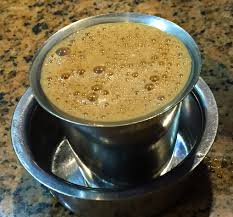
hearing. The ladies wanted their coffee in what they called 'those little south
Indian glasses and katories'. They got what they wanted.
After
coffee, beer flowed. Burra Sa'ab and Mem were full of praise and thanks for a
wonderful morning.
Ghenwa had
ensured that I didn't enter the kitchen, and I honestly have no idea, to this
day, how he managed that show.
Written for Indian Chai Stories


