Wednesday, August 08, 2012

Into the Sunset

The rain has eased a bit now. Late evening is my favourite time of day. I like to come indoors just before we turn on the lights. By that time, it's well past susnset. Some sunsets have nothing to do with the sun. It's the atmosphere they create.

 I took these two pictures near Kalchini town on one such evening.


Some sunsets are spectacular. You just want to stand and gaze and marvel at the show up there. Until someone - in my case, the gardener - asks you why you aren't taking pictures. Like this one on Sunday last.


Wednesday, June 20, 2012

MamMoth!


Today an interesting creature happened to be passing by and stopped for a while outside the jali kamra. It looks like something out of Harry Potter, with the two serpent heads at the wing tips!

Young Aruna, who works in the bungalow, was very happy to pose for the pictures.


Wednesday, May 23, 2012

Breakfast Spice


Many years ago, I wrote an article for a magazine about how I got as much excitement as a masala Bollywood film in the pre-breakfast hours in my bungalow. I was young, and our first born was a little baby. I'd oversleep because I slept whenever the baby did, and I'd wake to find no electricity, no gas, no cook, no bread or eggs in the house and the husband's motorcycle puttering at the gate!

I thought that was all history - after all I'd grown up years ago. I could manage things. Like the time when the cow decided to have her baby on the lawn and company directors were eating breakfast with us. The bearer whispered the news to me with a quiet smile, and I nodded with an equally dignified smile. No one knew what happened until the new mother and her young were in a state to receive visitors who took pictures of them. However, one can't take things for granted.

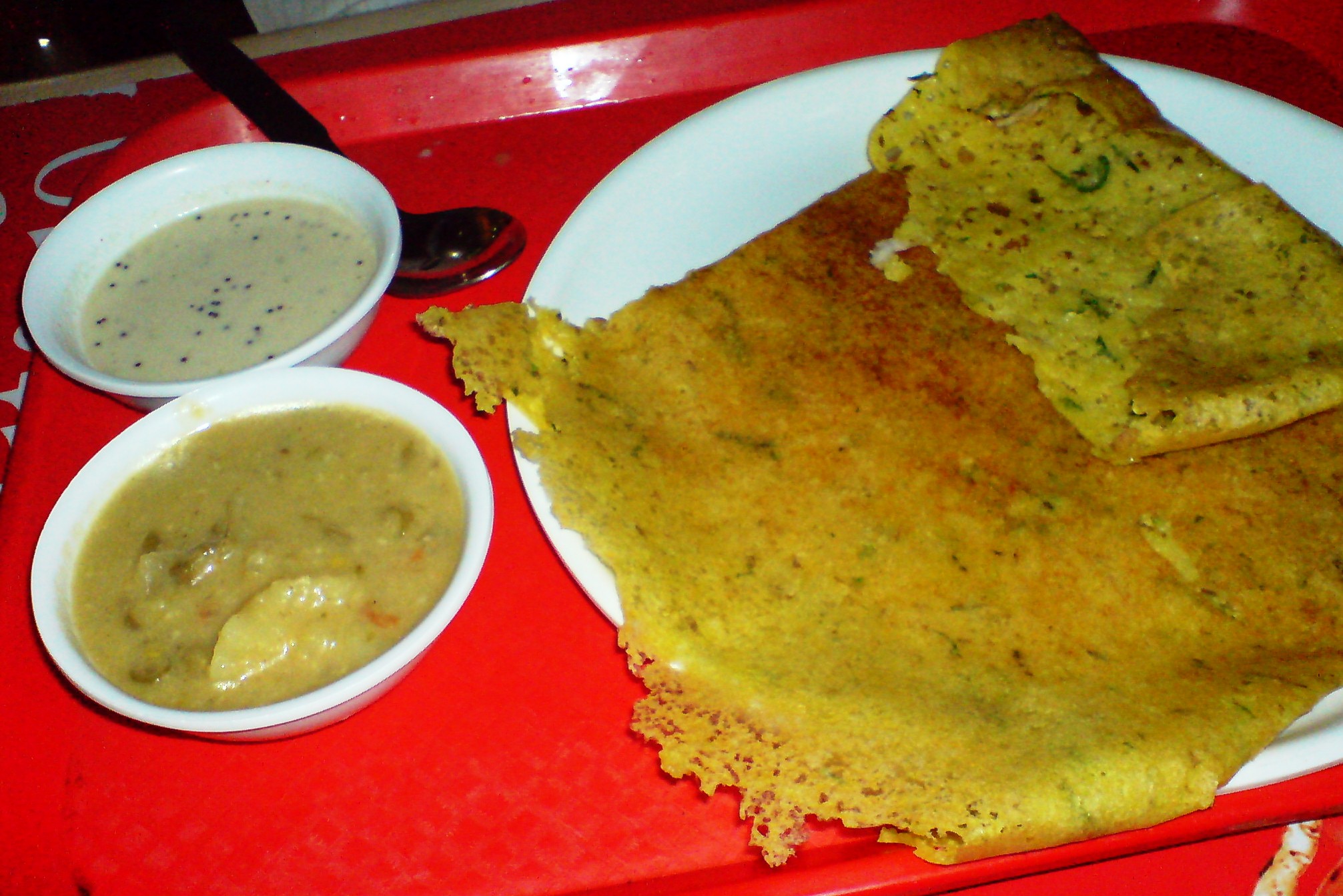
Image from en.wikipedia.org - this is what a Rava Dosa looks like!


Shankar, our old cook from Moraghat, always used to tell me not to plan Rava Dosas when we had guests. He said they were jinxed. Everytime he made those rava dosas for the family, they came out crisp and light, but lo, when there was a guest, all poor Shankar would get on his tava - or griddle - was scrambled rice lumps.

That was long ago. Or so I thought. We have been enjoying all kinds of dosas in our present bungalow, so when our next guests came to stay, I decided they'd get Rava Dosas at breakfast. After all a Rava Dosa is not just any old dosa, it's a delicacy. With my mother Maiji here, a lip-smacking sambar was guaranteed. Our cook knows his dosa and all I did was issue a few airy instruction in the kitchen before going off to see to the flowers arrangements and other trivial things.

We were seated at the table and the sambar and chutney were borne in in style. The bearer exited, only to come back after five minutes and give me a tortured look. I excused myself and went to the kitchen - I didn't rush, but just glided in - to find that Shankar's jinx had followed us here. There were congealed lumps of rice flour on two tavas and the cook was just about holding in his tears. 'Now what?' said his expression.

'Toast' I whispered to the bearer. 'Keep the saheb log busy.'

There was an extended toast session which must have puzzled my poor guests (some dear old friends).

When they could, my team served up some very apologetic dosa with excellent sambar and chutney. The cook struggled to keep the show going. He is not used to failure. He didn't break, even though the dosas did. The bearer served each person at the table with a look of deep remorse.

As if I wasn't feeling guilty enough, breakfast was concluded in great good humour, with everyone present praising the perfect taste of the dosas - and what do appearances matter, they all asked. What with looking light hearted at the table and trying to be a lifestyle guru in the kitchen, I'm quite ready to go to bed for a week after some amnesia inducing drink.

Friday, April 06, 2012

A Fool For April

Good Friday: Bleeding heart
comes into flower
after April showers.


It rained a little. Just enough to send our spirits soaring.
Could we ask for more? You bet we did.


More Haiku My Heart here

Friday, March 30, 2012

A Brown Study: Dry Skywatch


Brown skies, blue thoughts
dragonfly flits away: rain
will come another day


More Haiku My Heart at Recuerda Mi Corazon

More Skywatch Friday

Wednesday, March 14, 2012

Expecting to Fly


This moth was in the verandah for several hours in the morning.

I rushed to get the camera, thinking it might take off before the grand capture. No, it stayed. Some of us stood around and made comments. It didn't budge. Then I got the camera really close to it - and dropped it, typically for me. It fell pretty close to what I imagine were the moth's ears. Did it stir? No.

A good role model for someone who needs to 'chill' more.
 You can listen to Buffalo Springfield sing Expecting to Fly here.


Monday, February 27, 2012

And They Call It Poppy Love...


It is rewarding to write - especially when when you get interesting responses. When I read my brother Bala's comment on my last post, I decided to publish it on the main page. Here it is. Thank you, Bala!

"The moment I saw your Poppycock piece, I was transported back to my second year at IIT Delhi. There were five of us who would go to practically all the English movies showing at Rivoli, Regal, Odeon and Shiela.

In 1966, along came a movie called The Poppy Is Also A Flower with an unbelievable cast: Yul Brynner, Rita Heyworth, Angie Dickinson, Jack Hawkins, E. G. Marshall, and more. The five of were excited about the cast and went for the movie.

To say the least, when the movie was over we all walked out rather disappointed. It was more like a documentary and was all about something called heroin and drug addictions.

Heroin -- we did not know anything about the drug or the drug culture. Those days of innocence!More on the movie here: http://en.wikipedia.org/wiki/The_Poppy_Is_Also_a_Flower "


Saturday, February 11, 2012

Poppycock!


Winter. I know exactly what I want from winter in the Dooars. It should be pleasantly cool, with temperatures not lower than 11 degrees C, and no higher than 22 C. It should be just cold enough to justify the lighting of a fire in the place.

The joy of airing and wearing sweaters, snuggling into quilts and being able to knit without feeling suffocated by the warmth of wool.

Clear blue skies, sunlight to sit out in, no dust and no humidity.
Indolence.
Bonfires.
Picnics.
Flowers.
Oranges.
Peanuts.
Christmas cake.
Masala chai.

My mother has always said that the cold weather in Delhi is wonderful until Christmas, after which what she calls the 'dirty winter' begins. I can't think of a better description of those murky skies or those foggy days and nights with miserably low temperatures.

The Dooars is not as cold as Delhi, but here too, blue skies and sunny days come to an end by the beginning of January. In the morning, the fog gives way to a dust and cloud haze. Everyone seems to fall ill. We long for warmth, for an end to the misery of cold days and nights.

February usually comes with drought, chills, more dust, and an increasing difference in day/night temperatures which adds to the woes of those suffering from coughs and colds.

It's been different this year. In most parts of India, winter began early and seems to be in no hurry to leave.

For the last two days, we've had a replay of the early cold weather. The sky is blue, the sunshine is warm enough for me to lie about in chairs and drowse, and occasional chilly breezes bring the comforting thought that the weather won't hot up and spoil it all too soon.

My cold weather garden has a very few blooms. We moved into this bungalow at a time when it was too late for me to plan or plant the garden. The previous occupant had had no time either, being caught up with packing for retirement.

So I have what the mali (gardener) could manage with his own resources. I never grew poppies after our chhota bungalow days, becoming very picky as I gained seniority - not necessarily wisdom - as a tea memsaab. Poppies were things I looked down upon. They have this tendency to blaze for a day or two in glory before fluttering away their all in a mess on the ground. It's tempting to think of them as wastrels. They are completely out of place among superior species that hold their heads up as the well cultivated should.

Well they hold their own here - however fleetingly - and they have silenced me. I'd forgotten their depth of colour and the richness of texture of each petal. The 'mess' of fallen petals makes the ground come alive with colour. I'm willing to eat my words – and the poppies too - if it will prolong the heady daze of these extended cold weather days.


The sky at noon - from under a favourite tree

Thursday, October 27, 2011

Hang Out There!

Tindharia in the Darjeeling hills is the first important railway station on the Darjeeling Himalayan Railway (DHR).
It is on National Highway 55 which connects - when it is in working order - Siliguri to Darjeeling.

We drove up to it one Sunday afternoon with some friends last July. One of them, a Darjeeling tea expert, pointed out the Tindharia Locomotive and Carriage Workshop to us. The three rooftops perched on the top of the hill made a pretty sight.

We drove past and went up to the railway station. It was also a lovely old building. I wished we could have taken a train ride there, but the train service had been suspended because landslides had snapped the road link and damaged the tracks beyond Tindharia.

We wondered whether repairs would be completed. The scene changed completely in September, when the earthquake struck. A large part of the hillside below the locomotive workshop fell away.

We drove up in the direction of Tindharia today with our younger daughter. She loves the railways, particularly the DHR. This time we couldnt even reach the station.

I did not have my camera with me. These pictures were taken on my old fashioned (four years old is old fashioned these days) phone camera.
No complaints. They pretty much convey what we saw.


The Darjeeling Himalayan Railway (DHR) is a World Heritage site.

The UNESCO World Heritage Committee describes it thus:
"The Darjeeling Himalayan Railway is the first, and still the most outstanding example of a hill passenger railway. Opened in 1881, it applied bold and ingenious engineering solutions to the problems of establishing an effective rail link cross a mountainous terrain of great beauty. It is still fully operational* and retains most of its original features intact."

*see above

Saturday, October 01, 2011

Hello, darkness my old friend!

Darkness everywhere. It terrified me, a Delhi girl in my early twenties on my first evening in a tea garden. That night, a few of us rode from Birpara Tea Garden to Lankapara Tea Garden in an Ambassador car. 

It was a memorable ride - the car hurtled into the darkness at top speed. It was hard to believe there was a road. There probably wasn't. I'd never been in such inky darkness before. When the terror of the ride ended, there were the introductions to strangers at the party. I was the new bride in the district. There was only one reason I didn't want the evening to end. The drive would have to be repeated. 

 While stepping out of our hosts' bungalow, I looked up at the sky. There were stars everywhere! I'd learnt to recognise the major constellations and the planets in Delhi's night skies, but this sight made my head spin. There were stars where I'd been used to seeing dark spaces. For the first time, I saw the Little Bear - Ursa Minor. It had only been a name on a star map before this. In Delhi, we could spot two stars from Ursa Minor - the Pole Star Polaris, and Kocab. These stars augured well - I was going to love a lot things about my new life in tea. 

I missed the city lights. Here, darkness fell by six-thirty in the summer and by five in the winter months. Thirty-five years ago, there was no electricity anywhere in tea gardens save in the bungalows, factories and hospitals. 

The towns nearby were not much better. There was no street lighting, nor were there any neon signs. Our daughters never feared the dark as babies. They wouldn't cry or get restless when the lights went out. My husband always said that this was where we failed, having grown up in a city! 

I can't say when I started appreciating the darkness in a tea garden. But you do need darkness to appreciate the beauty of light. My cousin Ambika wrote about this on her blog. She had linked another article for star gazers. It is really sad to think of children growing up without seeing stars in the night sky. 

For some years now, I've enjoyed taking a solitary outing at nightfall. All those years ago, the loneliness was as frightening as the darkness. Over time, a love of solitude replaced the fear. 

Silence and darkness can become a rich environment for those who like to wander about in the spaces of the mind. We should be alright in a world where 'Daylight is good at arriving at the right time'.*  

Beware of darkness - George Harrison

Watch out now, take care 

Beware of the thoughts that linger 

Winding up inside your head 

The hopelessness around you In the dead of night - 

*George Harrison, 'All Things Must Pass'

Monday, September 19, 2011

Earthquake!

Sunday evening, Biswakarma Puja Day. It was chilly and it had been raining for nearly twenty four hours. My daughter Swati, my husband Mohan and I were sitting with our cups of tea. We were arguing idly about whether we should catch a movie later in the evening. Suddenly Swati said, 'Earthquake!'

I had just felt a little movement, but hadn't identified it.
'Run, Ma!' she said, and already, everything was shaking violently. A loud grinding and rumbling sound started off.

We were shaken and rattled about. The lights went off at once. The noise was frightening. Once we made it outside we stood together holding one another at the door. We knew we should be running down the stairs but we couldn't move. The building was rocking violently. It felt as if everything would come crashing down any second.

We heard people wailing loudly from the direction of Siliguri.
The last time I'd heard that many people shouting was when India won the cricket World Cup.

We stood hugging one another, unable to do anything more than keep our balance. It was pitch dark. We couldn't see the stairs. As soon as the shuddering stopped, the lights came on and we took the stairs down - gingerly, because they were slippery after the rain. Two young girls who live upstairs rushed down, sobbing loudly.

Everyone in the three buildings that make up our apartment complex had come down.
No one was hurt but people were just too scared to go back inside.

We looked up and wondered if the structures would all come down any minute. We saw tall cracks - as high as twelve to fourteen feet - around many of the walls and pillars on the ground.

'We should live in a bungalow again!' I said to Mohan. We've felt a number of mild earthquakes over the years. In a bungalow, it would take a moment to run out on to the front lawn! And those old tea bungalows were built to withstand more than earthquakes.

Ten days ago, Delhi had an earthquake. My brother and I were chatting about it on GMail last week.
"Was it scary?" I asked.
"Nothing serious ... not scary ... but it's a unique feeling ... a wave which passes through your body ... your head stops feeling it by the time your legs start feeling it"
"You make me want an earthquake!!!!" I said ... and he reminded me of these words when I spoke to him later in the evening.
It felt a little eerie to re-read that chat. He'd written, "The feeling reminded me of all of us watching the landslide in Sikkim...it oozes"
Today's quake had its epicentre in Sikkim, less than 60 kilometres from Siliguri.

Time calmed us all down. I stopped holding on to my daughter. We walked around a little freely. We tried to call our elder daughter in Delhi. All the phone lines were jammed with similar panic calls.

My husband walked around inspecting the cracks with some of our neighbours. 'Only the brick work and plaster have cracked,' he said. 'The pillars are unharmed.' Only then did we think of climbing the stairs back up to see what damage had taken place at our flat.

No, the building was not going to collapse for now. Still, all the neighbours pulled their cars out of the ground floor parking lot and parked them out in the open.

In the flat, we grabbed our cooling cups of tea and checked the damage. A broken photo frame, a chipped plate, some books knocked down. My 'puja' in disarray. Nothing too bad. Nothing that couldn't wait till later. We put on floaters so that we could run if required, and went downstairs to wait in case there were aftershocks.

Swati and I sat down in the car, though she and her dad had already decided not to drive out to the wide open spaces like I wanted to. They both said we ought to leave the roads free for people who might need to be rushed to hospital.

We managed to make our phone call to our daughter Parvati, alone in Delhi, frightening and reassuring her in the same breath.

Three young boys from the our building walked by. They were in high spirits.
'We could have died!' one announced happily in a loud voice.
'How many times have we studied earthquakes in class! Who thought we would feel one!'
Swati and I couldn't help laughing when we heard them.

It turned out the boys had been to the movie hall - the one we'd been debating about.
They'd all rushed out when the false ceiling started crumbling down and the hall filled with clouds of dust.

One boy popped his head in at my window. 'You are going to sit the whole night in the car, Aunty?' he asked.
He couldn't be more than eleven years old, and he'd braved the earthquake in the movie hall.
'That will be silly, no?' I asked him. 'Want to sit with us?"
He ran for his life. Again.

This post appeared in The Statesman, Kolkata, on 20 September 2011.

Tuesday, November 16, 2010

A Trained Eye

When we were children, every time we went on a train journey, we would look out of the window at level crossings and feel sorry for the poor people who lived in the middle of nowhere between the big railway stations.

After I married my tea planter husband almost 25 years ago, I've lived in that world of unimportant level crossings. Our tea garden is just one of the sights that can be seen on the train line between Delhi and Guwahati.

One Diwali/Kali Puja night many years ago at the Kali temple level crossing near our home, the gateman kept the gates closed so he could light candles on the bars.

Those were days when there was less traffic. Every time a vehicle crossed, he'd open the gate and his candles would go flying. When he closed the gate, he would arrange the candles again and light them with great care, apparently undisturbed by the thought that they would only burn until the next vehicle came along.

It was a pleasant surprise to see a small puja pandal near the Chalsa level crossing. It must have been put up for Kali Puja, which was over ten days ago. A pandal's basic function is to provide a platform for placing the image of the goddess. Pandal decoration has become an elaborate and showy affair in the towns here these days.

This structure, however, seemed to be a labour of love - a work of art that came straight from the heart.


The model of the train engine was true to life, and the cabin a perfect replica of the real thing. Hats off to the people who built it. I'm not surprised they didn't want to pull it down.


Above: the 'real' cabin at the crossing. The number is the same as the one on the model.

Now that the festive season is finally over, I'm done with complaining about its drawbacks. Its good to see signs that people everywhere had their share of fun.

Monday, October 25, 2010

In the Moonlight, on a Magic Night

Vikram Seth's A Suitable Boy has a magical passage in which Kabir and Lata, young lovers, take out a boat on the river Ganga on Sharad Purnima night. Reading that passage aroused my interest in the night of Sharad Purnima, the brightest night of the year.

'Purnima' means the full moon, and Sharad is the name of the season that comes after the monsoon rains, marking the beginning of cool weather in most of India.

The Sharad Purnima is the equivalent of the equinoctial moon. During the equinox, the moon moves closest to the earth. So when you have a full moon around that time, it appears larger and brighter than usual. People in the Northern Hemisphere see the brightest full moon of the year around the time of the Autumnal Equinox, September 23rd. And I don't want to offend my friend Uma in Australia - you'll see yours in March.

Sharad Purnima did not coincide with the Equinox this year, but it occurred a month later.

The Sharad season begins in the Indian month of Ashwin (called Ashshin in Bengali, and Aippasi in Tamil). The Indian calendar measures time in terms of the sun as well as the moon, with the year measured in solar time, and the months in lunar cycles. The months in this calendar don't run parallel with the months in the global calendar. When Ashwin coincides to some extent with September, chances are that Sharad Purnima will coincide with the equinoctial moon. If not, it will be the full moon after that one.

The Ashwin moon is especially significant. The new moon or Mahalaya Amavasya marks the beginning of 'Navaratri', nine days and nights of goddess worship. In Bengal, it is the beginning of Durga Puja. The tenth day of the moon is Bijoya Dasami. The night of the full moon is observed as Lakshmi Puja.

Lakshmi is the goddess of prosperity. The moon is a symbol of plenty: a good harvest of course, but much more than simply wealth. The fulness and brightness of the moon on this night stand for fulfilment, the abundance of blessings, peace and well-being.
It is said that any wish made on this night comes true.

Seasons of Splendour by Madhur Jaffrey, a book my daughters read when they were children, is an interesting compilation of the legends and folk tales that surround Indian seasons and festivals. It mentions the tradition of threading a needle 100 times in the moonlight on Sharad Purnima night. The moonlight supposedly contains drops of nectar, which enter the eyes of the person performing this feat.

I love the Bengali tradition of Lakshmi Puja. It is a day of great piety. A religious festival like this one has a simplicity and charm quite untouched by the bustle and commerce of the 'big' festivals. Any festival held in a tea garden is enhanced by the surroundings: by the large open spaces, and the peace and quiet.

Unlike Durga Puja, which is conducted by a community of people, Lakshmi Puja is performed in people's homes. An elaborate feast is prepared. For many years, a Bengali family in our garden has been sending us 'bhog' or 'prasad'. There is luchi (the Bengali Poori), paayesh (kheer/payasam), narkul nadu (coconut laddoos) of two kinds, white and brown, and the delicious bhog khichuri (rice and dal savoury) with the vegetable side dish called labra . It is delicious - like all consecrated food offerings are.

In the Dooars, the moonlight is undiluted by city lights or smog. The Sharad full moon rises over treetops, and the silhouettes of the trees seems to shrink in contrast. The light is silvery all night. I stand and gape at the moon for as long as I can. It is said that standing in the moonlight and absorbing the rays is good for the body. It does your soul good too, I'd say.


Sharad Purnima was two nights ago, on October 22, but it was not the brightest night of the year in the Dooars. The sky was overcast until almost ten o'clock and we couldn't see the moonrise, easily the best part of any full moon night.

Last night, the moon was still almost full, as it was again tonight; a perfect round, and to our delight, perfectly visible when it rose.

Wednesday, September 29, 2010

Killer on the Tracks

24th September 2010 :

Seven elephants, including babies, were knocked down and killed by a speeding train at Moraghat Tea Estate. We live on the estate, which my husband manages. All of India heard the news over television, and it spread over the world in no time.


At 4.30 a.m., our chowkidar (watchman) Madan told us that an elephant, a large tusker, had entered the bungalow compound about half an hour earlier. It had walked down the half-mile long road from the highway to the bungalow. It shook the large iron gates open. It walked all around the compound.
The two watchmen on duty ran and hid indoors.There was no damage barring a few huge footprints on the lawn. And a gate connecting our bungalow to the deputy manager's bungalow next door was knocked out of shape. That gate was made of iron rods! My husband's phone started ringing before six o'clock. He knew it must be something serious. The caller was Joy, the assistant manager who looks after the NG Division. His news was about elephants as well: the train accident had taken place in his division near the railway line. This news had spread all over the garden as soon as it happened (around midnight), and some workers informed Joy. He told them not to disturb the manager so late at night.

We went to the site, a distance of around one kilometre from the bungalow. Hundreds of people had gathered there. A baby elephant's carcass lay in the wide drain near the track. The mood was gloomy as it was lifted on to a lorry.


Crowds of people from the workers colonies rushed to the spot as soon as they heard about the accident. All but one of the elephants were alive at the time. We heard that they were crying in pain. A little calf was walking around in the broad drain, which was filled with water. As more people gathered, they started calling out to the elephants.

'Ganpati Bappa, Morya!' they shouted, asking the elephants to get up and walk again. People say the elephants would have survived if they had been rescued earlier, and that the forest department should not have waited till daybreak to begin removing them. The poor animals must have suffered terribly.

Elephants kill at least one person every year on this estate, and there isn't a living soul here who doesn't fear them. An elephant is perceived as an enemy. All this was forgotten that night when they lay there dying.

Moraghat Tea Estate falls on the elephant path between two stretches of forest. Every one is aware that elephants begin to move around the area in the evening. A herd had been creating havoc for the past ten nights in the tea area, pulling down shade tree branches, uprooting fencing posts and flattening plants. The wildlife squad in the region must have been aware of their presence here. Perhaps they could have alerted the railways.

It is really strange that the train's engine driver did not see the elephants on a full moon night. People say that he was drunk. Some say he reversed the train at top speed after hitting the first elephant, and that was how so many of them got hit. Everyone asks why the signalman at the level crossing nearby did not alert the engine driver or the stationmaster at the previous station. There was some talk about the 'symbolic arrest' of the train's engine at Alipurduar station.

Train services resumed within hours of the accident, and we now hear a loud whistle when a train goes past. Every time a train anywhere in North Bengal hits an elephant, the whistles begin to blow. Once the outcry dies down, these precautions are forgotten. Reports say 26 elephants have been killed by trains in North Bengal in the last seven years.

Ironically, one man from Moraghat Tea Estate died at the site of the accident that morning. Jaisingh, sometime worker, was a smoker of 'bhang' and was always in a hazy state of mind. A lorry hit and killed him on the spot.

Yesterday, another piece of news came to light. The elephant that walked into the bungalow had not nudged the gate open. That was the work of the chowkidar Dhiraj, who spotted him in the distance and opened the gate to get a good look!

We expect more visits from the herd.


Wednesday, September 22, 2010

Kings of the Road!


The Teesta, from Sevoke

How lucky I am to live near this river. How much luckier I need to be if I want to reach this spot without being held up by road blocks, natural or man-made. Here's one of the man-made variety, below.


Issuing directions all around

These pictures were taken when we were waved down at a place around 50 kilometres away from Siliguri, and almost the same distance from our garden. The mob blocked the road using a favourite shield in the area-- school students. Their 'demand' was for a new 'request bus stop' on the National Highway. The children had to walk to the regular bus stop from their school because the bus drivers wouldn't stop when they waved them down.

Most of the buses on the highway run long distances, and surely the passengers wouldn't want random additional stops. How long did the children have to walk, my husband asked some chatty looking bystanders. He was told the distance was under one kilometre.

A peculiar feature of these roadblocks is that once the mob stops your vehicle, it doesn't allow you to reverse or retreat. The idea is to cause as much nuisance as possible to members of the public. Once you're in, you park your vehicle and sit quietly.

The mob is quick to feed on the mood and is on a power high. Youngsters - little boys who must be in Class 5 or 6- slap the rumps of vehicles and strut around.

If you ask any questions, it is in a soft and quiet voice because you don't want to inflame the already excited 'dada log' or bosses of the moment. In short, you feel you're trying to appease the people who have broken the law. I feel wretched, but I console myself with the thought that when the authorities turn up they will do the same thing and then proceed to negotiate.

Last weekend we were 'caught' again on the road to Siliguri. This time it was at a small settlement near the hills. The road - the National Highway, of course - was blocked by local residents and the children from two nearby schools. The previous night, a couple of children from the busti had been trampled to death by elephants. What a terrible way to die.

We didn't have to ask when the road block would be lifted. From long practice, we knew that it would remain in place until the 'concerned authority' (as we say here, and with no ironic intent) showed up with promises of a hearing, of compensation or redress. In this case the mob was waiting for the forest department officials to declare compensation for the families of the victims. The law is quite clear that every death caused by an elephant has to be compensated. I wonder why the protest had to be staged. Was it because of some past callousness or lapse? That was not the time or the place to find out.

As soon as two or three Forest Department jeeps arrived, we were waved on our way.


Too close for comfort. I wondered whether I was being foolish, taking pictures with my phone! At the first roadblock, someone screamed 'No Press' when a vehicle with a press sticker inched ahead. I heard another person shout that the press would report the roadblock, but write nothing about how the schoolchildren had to walk all the way to the public bus stop on the highway.


Jam on the Sevoke Road in the hill section
With naturally occuring road blocks like this one above, do we need to create more?

Friday, July 16, 2010

Flooded!

We had a tragic reminder of the intensity of monsoon rains in the Dooars recently. A trainee assistant from Chengmari Tea Estate got swept away by a flooded rivulet. He was on his way to the bungalow from the office on his motorcycle, and there were a few other people making their way home along the same route. All of them crossed the flooded stream just minutes before Debashis attempted it. His body and his motorcycle were found in the tea area several hundred metres away.

Dooars is full of rain-fed rivers that look deceptively small most of the year. Visitors to the area are quite naturally tempted to go in for a little paddle. People who live here maintain that you should only enter a river between the months of December and February. One year, a student from my daughters' school drowned in a river at Puja time in the month of October. There may not be too much water in the a river at that time, but the currents are strong, and the stones on the river bed are slippery with slime. A fall is enough to knock anyone senseless and the currents do the rest.

 
The tea area of 'NG' in the background.

These pictures were taken this morning after a night of rain. They were all taken from inside the jeep as it was still raining. The swollen flood you see here is not a river. It is the overflow from a storm drain that carries rain water down from the Bhutan hills.


Flooded section of the road to Samtse, Bhutan, and close-up, below.


Flooded paddy field to the left of the picture; drain to the right. Taken from the bridge across the drain.

This is all Moraghat Tea Estate: it is the division called 'NG' or New Garden. 'NG' is separated from the main division by the broad gauge railway track. On either side of the railway track there are roads - one is the National Highway 31 C that goes to Guwahati, Assam. The other is the road that connects us to Samtse, Bhutan. It is only used by Samtse residents and by the people living in the tea gardens that lie in that direction. The land between the tracks and the roads on either side is used for paddy, maize and mustard cultivation. It is under paddy at this time of year, but it's completely under water in these pictures. The drain, or the 'Haati Nala' as it is known, flows west (at that point)of the Bhutan road.

Since it had rained all night, the pluckers who'd been assigned to the flooded area were given work in the other division. Some jobs like guatemala* planting were held up, and people who were working on these were laid off for the day.


We saw a few of the planting men walking down the rail track. My husband called out to them and asked them to stay away from the flooded area. They said they'd only come to take a look since they had nothing else to do today. One of them smiled and said, 'Dhoop aaney se ek din dono bela kaam kar ke make up kar dega.' ('We can make up with a double shift one day when it's sunny !') Completely unperturbed - you have to like his attitude.


*A kind of grass, planted in areas where tea has been uprooted. It regenrates the soil before new tea is planted there.

Monday, June 21, 2010

Two in the (Tea) Bush

I used to think only Englishmen dying of malaria in colonial India could hear the brain fever bird. I had no idea that it's a bird we've been hearing for many years and I paid for this knowledge with one night's sleep.

It was a night in March, and the bird shrilled outside my window without a break. There was no way I could sleep. It felt as if the bird was crying inside my head. By morning, I thought I'd gone mad. The bird didn't stop. Morning is supposed to bring great clarity of thought to the human mind. I had my moment - it became clear that the bird was saying, 'Brain fever! Brain fever!'

There are three shrill notes which the bird repeats over and over. Then there's the variation. It breaks off to do a warble of continuous climbing notes that serve as a short introduction to the same old three note cry.

Once you find out what the cry means, you hear it even more clearly and you find yourself waiting for the next one. There's no way you can mistake it for anything else. My brother Bala, who was visiting at the time, thanked me drily one morning for having explained it all to him. He'd lain awake the entire night while the bird went full throttle outside his window. We two were fellow sufferers; my husband slept the dreamless sleep that comes to tea planters!

When we'd finished making plans to eat the bird for breakfast, we read as much as we could about it on the internet. The bird is called the Hawk-cuckoo. It is small - about as big as a mynah - and black in colour. It's Hindi name is 'Papeeha', and it's said to be crying 'Pea Kahaan' (where's my love?) in search of its mate. In Bengali, they say the bird is crying 'Chokh Geilo' (Lost my eyes!)

Vikram Seth's novel A Suitable Boy has a poem called 'The Fever Bird'. I could not find the text anywhere on the web so I've copied it here.

The Fever Bird

The fever bird sang out last night.
I could not sleep, try as I might.

My brain was split, my spirit raw.
I looked into the garden, saw

The shadow of the amaltas
Shake slightly on the moonlit grass.

Unseen, the bird cried out its grief,
Its lunacy, without relief.

Three notes repeated, closer, higher,
Soaring, then sinking down like fire.

Only to breathe the night and soar,
As crazed, as desperate, as before.

I shivered in the midnight heat
And smelt the sweat that soaked my sheet.

And now tonight I hear again,
The call that skewers through my brain,

The call, the brain-sick triple note--
A bone of pain stuck in its throat.

I am so tired I could weep.
Mad bird, for God's sake let me sleep.

Why do you cry like one possessed?
When will you rest? When will you rest?

Why wait each night till all but I
Lie sleeping in the house, then cry?

Why do you scream into my ear
What no one else but I can hear?

(A Suitable Boy; 1993, Viking, pp. 949-950)

I've always admired Vikram Seth's poetry, but this poem is especially meaningful now. The lines I like best are :-
'The call, the brain-sick triple note--
A bone of pain stuck in its throat.'

The mynah, crow and peacock are all sweet-sounding compared to this horror. It kept me awake for hours every night. I filled my time writing my own poems to the tormentor.
These are my two Hawk-cuckoo haikus:

Brain fever bird bores
sleepless mum. Delhi, daughters
dream of birds singing.

"You complain of noise.
We long to hear a bird singing:
Town, bird, a far cry."

The bird's frenzy reduced somewhat by April, but it still goes off like an alarm once every few nights. If you have never heard this bird, you're lucky. If you want to risk it, here it is on youtube: http://www.youtube.com/watch?v=tPPzdx0gX8k
**************

We hear another bird now, one that sings sweetly. The Indian cuckoo is called the 'Bou-Ko-Tha-Ko' bird in Bengali. Its song has four notes. The story goes like this. The bird has just brought his bride home. She is a shy girl who doesn't say anything. The bridegroom pleads, 'Bou, kotha kou', meaning, 'Bride, say something.'

In North India, it is said that the bird cries out upon waking and discovering that his bride has run away with her lover. He goes, 'Main sota tha'. (I was sleeping!) through the night. The song has a variation, where the notes move higher up the scale. This is also explained in the legend. The deserted husband makes enquiries everywhere. He hears that the lovers have fled to a town called Champapur. He decides to follow them and changes his cry to a more urgent call, 'Chal Champapur!' (To Champapur!)

Tea planters say the bird is calling, 'Orange Pekoe', 'Broken Pekoe' or 'Make more pekoe'!!
You can hear it here on wikipedia.