Saturday, March 17, 2018

Birpara : 'Bride and Prejudice'

Ghenwa the Jewel: A Birpara Story

One of the tough examinations I've had to pass in life was the test set by the bungalow servants in my first tea bungalow.
Ghenwa was cook cum head honcho of the world beyond the dining room. He looked like some kind of tribal Amitabh Bachchan: tall, thin, arrogant and unsmiling. He was a handsome man, with thick wavy hair, large brown eyes and lips that could smile when they weren't being curled. He couldn't have been much older than me, but he filled me with nervous fear. 

I, who had quelled classrooms of undergraduate students not four years my junior with one look just weeks before my marriage!

Mohan had been in the Engineers' Bungalow in Birpara for about a year before we got married. Ghenwa was a trusted aide. Mohan left the running of the bungalow to him, and Ghenwa served him with devotion; in fact he quite doted on him. He felt let-down when Mohan produced a bride at the end of one 'chhutti'. From Ghenwa's point of view - I see it now - it meant the end of independence, and a reduction in stature.
Mohan didn't want me to bother with the kitchen for the first few days. I was grateful only because I was too chicken to enter Ghenwa's domain. The bearer Joseph was a cute, smiling chap, quite cowed by Ghenwa, like me. He became an ally. He'd serve our breakfast in smiling silence while Ghenwa, after finishing up the cooking and delegating toast making to some unseen hands, would enter the dining room in state and take up his position at Mohan's right hand. He would stand there and declaim - a sort of daily round-up or news bulletin - in what was a strange lingo to me, and Mohan would reply in the same lingo. If Ghenwa wanted to make me feel left out, he succeeded. This colloquy would continue until Mohan asked him in Hindi what he was going to serve Memsaab for lunch. 

The first time I ventured into Ghenwa's store and pantry, I made a hesitant suggestion about the food. He gave me the full Amitabh Bachchan stare, and said by all means, I was free to issue any commands, but he could not guarantee that his saheb would like what I suggested. I fled.
I was the encroacher in his little kingdom, and I was too ashamed to tell my new husband how inadequate Ghenwa made me feel. His hafta chutti was probably the happiest day of my week. 
Once this tyrant went home at night, the chowkidaar took over as my chief tormentor. Etowah - that was his name -stole everything that wasn't nailed to the floor. Mohan told me how he'd served him tea one chilly morning wearing his - Mohan's - socks. When Mohan bellowed at him, Etowah swore those were the socks that a departing Chhota Saab had presented him many years ago. 
Another time, Mohan surprised him when he had his head in the fridge and several fingers in a bowl of custard! Etowah could also make sugar and milk disappear from bowls without a trace.
I was wretched. What kind of administrator was I, who couldn't even keep house for two without losing potatoes, onions, oil, milk and sugar by the kilo?
Life wasn't all housekeeping, though, and we had a lot of fun. Also, there were others like me, new to tea and with similar tales of woe. We all met regularly at the club or at one another's bungalows. 
There was a tradition of people coming in from the club in the wee hours to torment newly-weds in the district. We had our turn too. It must have been two thirty in the morning, when we woke to the sound of several cars honking outside our gate. We could hear voices yelling, 'Open up! Once the crowd of merry makers was in the bungalow, there was much leg-pulling and ribald laughter, and it was impossible to feel anything but happy. Everyone clamoured for coffee. Of course, coffee! That was the reason they'd all 'dropped in' barely two hours after we'd said goodnight, for an early morning cup of coffee!
I wasn't embarrassed when they'd all pounded on our bedroom door and asked how much time we needed to dress, but now, I was red in the face. By now, I thought, Etowa would have drunk every last drop of milk, copiously sweetened with every grain of sugar in the bungalow. Still, I rang the bell and weakly asked him to bring coffee. Everyone around me continued to shout with laughter and have a good time while I sat and waited for the ground to open and swallow me up. What was Etowa going to serve ? There must have been a dozen people there!
The door swung open and in he sailed, with my best (wedding present) cups on a tray, each filled to the brim with frothy and fragrant coffee. The sugar bowl was full, too. My nightmare was suddenly magicked into a happy dream! Today the man had changed his act: he was making things appear and not vanish!
Some months passed, with one or two more riotous night time invasions. These were no 'intrusions of privacy'. We didn't know what privacy was in those days, and I don't think we'd have cared much for it. What we had instead was community - a family that pulled you into its fold - in a world far away from home. If loss of privacy was the price we paid to belong, we were happy to pay in those days!! 
     'Family' Picnic

Ghenwa continued to dazzle and hold sway, and he must have been satisfied with my state of surrender. I had a brand new mixi and he had skill, and we'd started calling people over to eat. On one Sunday, we asked one of Mohan's oldest bachelor friends to breakfast. He'd - let's just call him B - he'd left Lankapara early in the morning and run into a colleague - T -in Birpara town. When he heard where B was headed, T called him a lucky man and said he felt like eating dosas too, so would he tell Mohan and Gowri that he'd be along soon with whoever was at the club?

 That was B's style. Our club – well, all our tea clubs - were filled with eccentrics, both men and women. I could just visualise T going in to Dalgaon club and standing at the entrance, announcing, 'Everyone's invited to Mohan and Gowri's bungalow for dosas! Chalo!!!' When B told us about this, my jaw dropped in horror. I could provide dosas, chutney, sambar et al for another couple of people, say three more at the outside, but the early morning tennis crowd from Dalgaon Club?? What kind of disastrous life had I let myself in for when I married this happy-go-lucky moustachioed man? 

The man turned out to be as big a crack-pot as any of his nutty friends. He laughed!! He summoned Ghenwa and told him to expect another dozen people and said, 'Tum pugaa do; sab ko khilayega!' (stretch your resources, feed everyone). He looked at me and said, 'Relax! Our man will manage!' What blind faith, I thought.

Ghenwa piped in, 'Hum pugai dega, Memsaab! Aap log pehle kha lega!' ( I will manage! you should all eat first!') at which Mohan and friend B, the invited guest, expressed complete agreement. 

By this time, Burra Sa'ab's jeep had rolled in, and Jusep Driver had unloaded a case of beer. Burra Sa'ab and Mem saab would be along soon, he said, but they wanted us to chill the beer. I was fretting about place settings at the table but the two mad men in my bungalow urged me to eat quickly, and I remember I did eat, even though it choked me to think of what would happen when the crowds arrived.

It was Ghenwa's show all the way. In great good humour, he even treated me with kindness, bringing me my coffee himself with an air of deference. I was in shock, I think. 

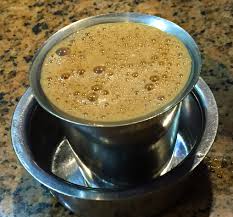
The crowds came. Burra Sa'ab and Mem Sa'ab, a few friends, some tennis players I knew only by sight and of course the villainous T. Ghenwa fed them all until they swore they'd had enough. 'Excellent!' 'Brilliant!' 'Genuine South Indian taste!' was what I kept hearing. The ladies wanted their coffee in what they called 'those little south Indian glasses and katories'. They got what they wanted. 

After coffee, beer flowed. Burra Sa'ab and Mem were full of praise and thanks for a wonderful morning. 

Ghenwa had ensured that I didn't enter the kitchen, and I honestly have no idea, to this day, how he managed that show.   
Image result for coffee davara tumbler 

Wednesday, January 31, 2018

Loony!

I miss my father whenever there is an eclipse. He'd have been amused by the media hysteria around this 'triple' phenomenon or 'three-for-the-price-of-one' hype which is all around us.

When there was a total eclipse of the sun in India in 1980, there was no internet or satellite television. We didn't even have 24 hour telecasts on our lone TVchannel. There was a special telecast of a very popular Hindi film to keep people indoors that afternoon.

My father thought it was ridiculous to create fear and keep people indoors during a solar eclipse. Delhi only had a partial eclipse, but it was exciting enough. We assembled a couple of simple 'eclipse viewing kits' and he said we could get some customers to watch if we wanted!! Only, the streets were deserted on that February afternoon in Delhi. I was quite happy to stand outside with my father and watch the reflection of the eclipse in water. Many years later, my wish to see a total solar eclipse came true.

In tea gardens, if a thing is heard or seen on television, it is accepted without question.

I put on one of the news channels this evening to check the time of the eclipse. I couldn't help but feel a little superior, as one who's known all about these things since childhood. I put on my coat and went downstairs to take a look at the sky. From the stairs, I heard screaming and metallic banging sounds coming from the workers' colony nearby and froze. The first thing that comes to mind is elephants - but there are none where we live. It had to be the eclipse! It must be whopper of a show, I thought.

Out in the open, the sky was dark, with not a glimmer of light anywhere, not even a star. The shouting and metallic banging continued. The sky was covered with clouds!

Half an hour on, status quo.

One hour later, the celebrity hadn't shown, but appeared to have cancelled without notice. Pink Floyd wasn't playing Dark Side of the Moon tonight. We'd got 'Obscured by the Clouds' instead!

The bawarchi came in for his evening shift. I asked him what was up, since the sounds had died out. They must all have gone home, he said. He was in social commentator mode today, shaking his head sadly. 'Baap re! Anyone would think a wild animal had entered the village. They didn't see a thing, but they screamed and shouted!'

Monday, January 22, 2018

A Pepper Tiger


Pepper's my favourtie spice. We never had to buy any in the fifteen years we spent in Moraghat Tea Estate, where it grew in abundance. We planted some vines in Bhatkawa T.E. and some here in Thanai, too. The photographs above, however, are of the peppercorns we bought in Tinsukia town yesterday. Our vines haven't fruited yet.

We bought one kilo of black and half a kilo of green for just R.120. What a steal!

Green peppercorns are popped into boiling water for a couple of minutes, when they turn black and are ready to be dried in the sun for storage. The black ones that we found in the bazaar yesterday had already been boiled and were damp, so we gave them another good boil at home.

I plan to use the green ones for another couple of days before boiling them up.

The veggie bazaar at Tinsukia is one of the most colourful I've seen, and if I hadn't been on a pepper chase, I'd have stopped to take pictures!!

Wednesday, January 03, 2018

Waste Not...


I'm trying to define thrift in today's terms. Is thrift a virtue, or does it have only recreational value?

These questions weren't relevant when I was a child; that was the era of hand-me-downs and  re-invented leftovers. The word recycling was unknown because it wasn't needed. Everyone recycled what they could as a matter of course. You didn't buy new socks when the elastic wore out, you bought lengths of elastic and stitched them into rings big enough to hold them up. Our mothers unravelled old sweaters and knit them up again. Sewing and knitting were necessary activities, not just hobbies.
We didn't have a glut of readymade garments in our cupboards or even in the shops. Markets held goods and goodies in plenty, but they weren't exactly spilling over. Nor did we buy compulsively. We didn't shop for fun so much, or because it would make us feel better. We didn't feel deprived either. That's the way the world was those days.
Thrift isn't just a matter of survival; it involves some level of ingenuity, because you manage to make something useful out of something you would have discarded.
There are plenty of videos of handy hacks on the internet. One of them showed how to turn  an old summer top into a shopping bag. That too an environment friendly bag, a good way to say no to plastic.

The top, and the bag, below

Two days back, I was forced to recycle for an old fashioned reason : want. The New Year arrived, but no calendar came with it.
I remember what my dad had done one year in a similar situation. He turned the pages of the previous year's calendar until he found a month with thirty one days, and the first of the month on the same day of the week as New Year's Day. With his firm handwriting, he wrote out 'January' and then the year.  I thought it was brilliant, because I wasn't very good with numbers. The makeshift calendar went up on the night of the 31st.
That was how it was with my father; he changed the page on the daily calendar just before he went to bed. That simple act was hugely reassuring: no matter what happened, tomorrow would come along at the right time.
My calendar went up at noon on New Year's Day. And as it happened all those years ago in my parents' house, someone brought a calendar for us in the next twenty four hours.


Sunday, December 24, 2017

Christmas Eve

We went to the Venkateswara temple after a long time this evening.

It was late. The priest welcomed us and told us Arati was about to begin. The lights were switched off. There was small cradle placed in front of the main deity. The priest lit an oil lamp and he rocked the cradle gently. Then he drew a curtain all round it and offered us prasad: a spoonful of warm, sweet milk.

This was the 'Shayan Arati'. The Lord, in infant form, had been put to bed for the night in a tender and reverent ceremony.

In the darkness around the tea gardens of Dibrugarh, every pond I crossed on my way home had a reflection of Sirius rising in the East.  

Monday, August 14, 2017

Gul-e-Fanoosh and the Pitfalls of Photography

Here is an old favourite. We had a number of these shrubs in my childhood home, and they all had pink flowers. I would stand under the branches after the rain and get a little 'shower' shaking water off the petals, long after I'd crossed the age when it was alright to play with water. 
The sight of these flowers always reminds me of the end of summer holidays. Schools reopened in the second week of July, some days after the monsoon set in over Delhi. Delhi was really beautiful those days, neither dirty nor crowded, but a city of gardens.

This is the tallest Gul-e-Fanoosh I have ever seen. 
 Botanical names are rarely pretty and lagerstroemia indica is no exception. I found some common Indian names at The Flowers of India website. Gul-e-Fanoosh isn't mentioned there. It's a name I learnt from this lovely old book pictured below, which my brother Raja found in a book godown  in Siliguri.


A 'pitfall' can be quite painfully literal, as I learnt after slipping and falling into this pit of 'jabra mal' or dry leaves and cut grass.
                 

Thursday, August 03, 2017

Marvel of Peru

I have always had a running battle with my malis about the merits of local flowers.

Our mali in Moraghat, Mithoo, was a terrible snob who always pooh-poohed all the 'local' flowers that I loved to propagate. Cannas and hibiscus were 'common' in the gardens of labour houses and they were not fit to be grown in Burra Bungalow, he would say. We did battle for a good fifteen years, and like all people who disagree, we have a strong bond and a healthy respect for each other. 
        Mithoo in 2008
 
When we moved from Moraghat he made it a point to visit us every year just before the cold weather planting began. He'd bring seeds and seedlings of hollyhocks and cineraria, dianthus and asters. After his visit, I would hear how he'd been saying that I'd had taught him everything he knew about flowers. That was good of him, and it was not entirely true.

Mithoo regrets that we have moved to Assam and that too to Dibrugarh district, which is 'so far away' from the Dooars. When he last called, he said it would take him a day and a half to reach us and another day and a half to return. How would he ever get enough chhutti to 'pugaao' (reach) all the plants to me? He's promised to try and get away, though.

Thank goodness none of my friends was as stuck up as any of these gardeners who scoffed at any plant that didn't have an English name or lineage.

While we were in Moraghat, we'd see a lot of pretty yellow and magenta flowers which opened only in the evening. My mother knew the Tamil name, it was the 'Naalu Mani Poo' or 'Four o'clock flower'. I remember seeing some outside the homeopath's clinic in Mal Bazar. When I asked Dr. Sarkar, he was most happy to let me take some rooted cuttings.

Last year, when we came to Assam, we met many people, some for the first time, and some after a gap of over two decades. Mrs Bagai - Ashima, she hates formality - was someone I met after over 25 years, and it was as if those years in between had never been. It was wonderful to 'talk plants' together, among other things. It was thanks to Ashima that I got to know that one of the fruit trees in our compound was actually a fig tree!!

One evening last cold weather, I spent a few happy hours with Ashima in her garden. I came home with lots of cuttings and seeds, and among them there were two packets which her malis had packed and marked 'Red' and 'Yelo'. I was touched that they had taken the trouble to write in English. These were 'Naalu Mani Poo' seeds. I wanted to learn what the English name was, and Google came up with 'Four o'clock flower' when I entered 'Naalu Mani Poo'! I was delighted. This was so wonderfully accurate!! And what's more, the Tamil name had been 'recognised' without a hitch.

The seeds sprouted and the seedling plants grew quickly. I'd never seen so many colours among these flowers. I was in for another surprise; a single plant bore blooms of different colours!

Some flowers were speckled and some...well, pied ( I have never forgotten Jacob and Laban and the sheep from The Merchant of Venice). I love the way the flowers mirror the colours of what we call 'kite paper'! Nothing like Indian flowers, my jingositic inner voice kept repeating to itself.

That voice fell silent today. I googled 'Four o'clock Flower' and got 'Mirabilis Jalapa' or 'Marvel of Peru'. Peru! How remote, how exotic, and how - well, marvellous.


Friday, June 30, 2017

Plum Crazy!!

Plum Crazy! That's what the husband called me when I lopped several branches off a couple of plum trees that were blocking the sunlight from a bed of cold weather blooms last January.

These trees were growing plumb (forgive me, I can't resist) in the middle of a bed of gerberas and nasturtiums, a vivid visual cocktail that was still in the getting-ready-to-hit-you stage. No flower lover could blame me, surely, for wanting to give them their due?? And after all, there were three other plum trees growing in a line nearby with branches reaching up high enough to threaten to bring down all our electric wiring.

As for the fruit, well, here's when things begin to get sour. The plum trees are quite lovely to see. Hands up all those who remember 'Lemon Tree' playing on the radio when you were young. You get it?
When we'd just moved to Assam and to this garden, I'd spent many happy hours photographing the trees with new foliage, then later on with blooms and finally, laden with jewels of fruit.

 The blossoms, above, against the blue cold weather sky


 Harvest! Plum heart with peach border
There were enough fruit to set me off on a frenzy of jelly making. We couldn't eat them just as they were. Our local expert made us a bottle of pickle with a new and unusual flavour, and a bottle of syrup as well. The jelly was much more tart than we'd expected it to be in spite of the amounts of sugar and the number of sweet Assam lemons we'd used up in it.
Whenever I'd made plum jelly in Moraghat in the Dooars, the fruit flavour would begin to 'awaken' after about a month or so and it kept getting better and better over time.  So I took some bottles to family in Delhi - only to find they'd left them in their fridges, months later, almost untouched. The jelly just seemed to be getting more and more sour over time, they said.

My husband didn't exactly say  I was unleashing my anger on the trees when I axed them, but the words seemed to hang in the air alright.

I reminded him of our Moraghat plum tree and how, after one of the April storms that we call 'Kaal Baisakhi' had attacked it we got fruits that were large and juicy. He went away mumbling about forces of nature and madness being two different things.

July is almost here, and the fruit's coming in now. The trees that were left untouched yield plenty of plums everyday- small, hard and sour, but I'm not buying sacks of sugar again! The trees that I, shall I say, treated, have fewer fruit: naturally, because they have fewer branches. But quantity is just not the same as quality.

See the picture!! Guess which ones came off which trees!
Joy in the Morning!

Wednesday, May 10, 2017

In the Maize


It's one of those post rain mornings. The wind lashed about last night after a hot and humid day, and the corn in our mali bari suffered its effects.

 The corn wasn't flourishing anyway, not with all the birds pecking away at it happily.

Just last week, we put in some scarecrows.
These men of straw were laid low by the rain and wind, and they looked quite wretched in the morning. I kept thinking of Ruth amid the alien corn. Some had lost their shirts as well - no doubt they took them off, as Nirmal the bearer said, because yesterday was so hot!!


                    Dignity restored!!

Saturday, April 29, 2017

The Good Old Days Weren't Always Good


This story is short - and sweet (you'll see why).

After griping about how it was impossible to get good 'gur'/jaggery/'vellam' in my last blog post, I decided to take my chances and shop online. Life can be full of sweet surprises. My favourite golden sugar was available at Amazon!
At Rs.69/- only for 500 grams, a packet of organic gur seemed like a steal.

I placed my order and got a message telling me it would be delivered by the first week of May, but the goodies came in today with the newspapers: a whole week early!

The packing was great, and the gur, chunky cubes of it, as golden and sweet as the cold weather sunshine!

We still have a 'dakwallah' in tea gardens - but now he brings in my online shopping as well!
Cheers to progress!


Saturday, April 22, 2017

Monday, March 27, 2017

Haiku : Death in the Hollyhock

March of death : heat and insects.
New heads bloom with rainfall - on broken necks.

Tuesday, January 03, 2017

Sweet Golden Memories


(published in the Hindu, 3/01/2017)
Karthigai has always been one of my favourite festival days. It is celebrated on a full moon night, and this year it was on Tuesday, 13th December. Sisters light lamps and candles and pray for their brothers, who express their love and thanks with gifts.  When my daughters were little, they too lit lamps and candles with me in our tea garden home in North Bengal just as I'd done with my mother and sisters when I was growing up in Delhi.
Most of the goodies offered up with prayers on Karthigai are made with jaggery, which is called Vellam (VELL-um) in Tamil and ‘gur’ (rhymes with ‘good’) in a number of other Indian languages. On Karthigai my mother would make Vella Dosai, Appam (little deep fried dumplings) and pori undai (puffed rice laddoos in golden vellam syrup) in large numbers.
I remember that Vellam was always sold in rounds about ten inches in diameter with slightly raised centres – around three inches high. Vellam has a grainy texture, and it is firm, but soft enough to break into chunks. We ate small chunks of it with dosai and adai at home, at 'tiffin time', that traditional South Indian meal eaten somewhere between three and five in the evening. Most children who grew up at the same time as I did thought tiffin was the best meal of the day. You got traditional fast food    (though we didn't have that phrase those days) like dosai and adai, uppuma, pakoras (called Bajji) poori-masala and idli (not a favourite with most children). These were actually good for you, in addition to being delicious. There are brown and white versions of many traditional Indian eats and the brown ones are all made with Vellam. There’s white Pongal which is a savoury and Sakkara Pongal, its sweetened brown version. Vellam gives us health benefits in the hot season as well.  I remember my mother preparing  glasses of icy ‘paanaham’ – a  gur sharbat flavoured with dried ginger and cardamom- which kept us cool during the days when Delhi’s ‘loo’ wind was at its height. The taste beat Roohafza or Nimbu pani or any other pani.
Vellam is probably the purest form of cane sugar. It is unrefined and rich in moisture, iron, minerals and 'heat'. It is high in calories, but these are ‘good calories’ unlike the ones in refined white sugar. Shakkar is another form of golden unrefined sugar, a little lighter in colour and powdery in texture. Fresh stocks of Gur and Shakkar arrive at grocery shops at the beginning of the cold weather. I found both in Delhi on my visit there last month.  Both were excellent. Only small quantities of Gur and Shakkar make their way into the rural areas of Eastern India. 
 
  A couple of months back, I bought some Gur here which was awful. It was adulterated with caramelised white sugar. Hard to believe it, but the cost of Gur has been higher than that of white sugar for some years now. It used to be cheap and available everywhere: the poor man’s sweetener and a traditional rustic dessert. In the nineties, my husband and I would take the train to Madras, and when we passed through the poorer parts of rural Orissa vendors would sell us tea sweetened with Gur.
I remember days of sugar shortage and rationing. That was also the age when readymade garments were costly and you got your clothes made by the tailor, when all our vegetables and fruits were not evenly sized and brightly coloured hybrids, but actually tasted of the earth from which they came.

The Bengali month of Poush began a few days ago, and with it, the open season for bingeing on sweets, particularly those made with Khejur Gur.
Khejur Gur is Gur made from date palm sap. The sap is sweet and ready for collection at the beginning of the cold weather, and it gets sweeter as the weather gets colder. I saw and tasted my first Khejur Gur sweets when I got married and moved to the Dooars, North Bengal.  They weren’t all that well known outside Bengal in those days. Once I tasted them, I was hooked for life. Bengali Khejur Gur sweets are golden and boozy in flavour, with a mellow richness that can’t be matched. We used to travel the length of Dooars at least once a week, and my husband managed to hunt out the best eateries and sweetshops in all the little towns. Pretty soon, we zeroed in on Nagrakata, Mal Bazar and Bagdogra (in that order) as the places which stocked the best ‘Khejur Gur er Mishti’.Around five years ago, there was a sudden drop in the quality of these sweets. The sweetshops stocked them in large numbers, but alas, they no longer tasted the same. It didn’t take long to discover the truth. There was no Khejur Gur to be had anywhere, and the sweetshops had switched to caramel.  This happened because there were no Khejur (date) palm trees growing anywhere any more.

                                    Khejur Gur and Sandesh from the 'Gur Old Days' !

Some photographs from The Telegraph, taken in Nadia district, show how date palm sap is collected and how the 'gur' is made and sold at the market.

Sunday, December 25, 2016

Saturday, August 20, 2016

Thursday, April 14, 2016

Celebration Lilies


 Easter lilies are so special. They almost always bloom on April 14, which we celebrate as 'Vishu' or New Year's Day. There would be a vase full of them in my mother's 'Vishu Kani'.
My mother remembers that when I was very young, I'd  pluck all the buds which were just about to open. She and my father would be waiting  to see the flowers and all they got was headless stalks.
 I must have been a monster of an infant. Thank God for parents who brought me up anyway - and passed on their love of flowers to all of us.
 

What joy to go around a new garden, checking what plants there are! And what joy to see Easter lily leaves, to know that there will be flowers in March or April. Those few days when they bloom are enough to keep you going through the year.

Our garden at Moraghat Tea Estate had both red and white lilies. The reds bloomed first and then the whites. Once the flowering was over, we planted the bulbs out in rows - something we carried on doing for the fifteen years we lived there.

The nuns from St.James School and Holy Cross School at Binnaguri would drop in to collect lilies from us to decorate the church on Easter Sunday. We shared our bulbs with them too and in time to come, they had enough lilies in their own gardens. I did miss their annual visits!


                                Moraghat Bungalow                    


                                Bhatkawa Bungalow

Our next bungalow was at Bhatkawa Tea Estate, and my garden there didn't have a single Easter lily! I moaned about it for all the three years that we were there. You don't find Easter lilies in nurseries, you get them from friends. My friend in the neighbouring garden didn't have any in her bungalow either, and between us we knew no one in the district on whom we could descend to beg for bulbs.

There are several Easter lilies in the garden where we now live and I'm grateful to the people who must have planted these. They bring back so many memories.

 A good way to start another New Year, giving thanks for life, for family, for friends old and new.
 

Wednesday, April 13, 2016

Reflections of An Evening, written 2007


In Delhi, in the seventies, we used to look out for sunsets in the monsoon and post-monsoon months of August and September without fail. In a big and dry city like Delhi, rain was incredibly energetic. It was always a bonus; it brought high spirits, and it spelt romance. Spells of rain never lasted too long, and when they ended by evening, we got the additional treat of a sunset to enjoy and remember.

Evening curfew for a young girl like me in those days was lighting-up time. As soon as the street lights came on, I had to be home. What lovely late evening twilights we had. The light would fade slowly and grandly out of the sky, lingering until the clouds and trees were dark silhouettes. In my imagination, those banked up clouds on the horizon, black and purple masses, were mountains. The return home at the street light hour was followed by prayers in the back verandah. The puja was in the store room that opened off it. The back verandah would be lit only by the fading daylight and the storeroom was beautiful in the dark. It was comforting and yet exciting, and there were many smells that filled it: the sharp smell of the scrubbed brass villakku or the smoky smell of burnt oil wicks, the scent of goodies stored in big biscuit tins, and agarbatti, which dominated, and then took over my senses with its calming effect so that my troubles -- homework undone or a test the next day-- would be washed away. Only the comfort and the safety of my parents' home would remain.

It was remarkable that one could connect to nature in such a profound way in the heart of Delhi.

That was a long time ago, and the habit of enjoying a few quiet moments gathering one's thoughts at the end of the day remains. On some evenings, the day seems to die, and it has a melancholy feel. On other days, there is only a feeling of peace. Today, I was sitting outside our house and looking at the Bhutan Himalayas, purple and black masses against the Northern sky, and I dreamed they were the clouds of my Delhi childhood. One peak stood out sharply defined, perfectly symmetrical, and in the foreground, a gulmohar leaf swayed in the silent breeze. It could have been a calendar picture of Mt.Fuji with a leaf etching in front.

It rained all afternoon after an incredibly hot and sticky morning. The thunder was deafening and it was a really dramatic, high intensity storm. It cleared the air magically. By four o'clock, the sky was washed blue and the hills stood out in clear relief. I walked down to the National Highway -- a straight road leads to it from my house - at about five o'clock, with my head turned right to see the hills. They were silhouettes; I couldn’t see the trees on them at all, but I could see the ranges layered out distinctly. Where the sky met the hills, it was a lighter blue than anywhere else; almost whitish, and luminous. The silence that settled around this spectacle made me imagine it was a pre-dawn scene, as if something big was about to happen soon.
Back from my walk, I sat outside on a swing, with our patient and undemanding dog Simba at my feet. There was a gentle breeze blowing. Birds had returned to their nests and fallen silent. A truck rumbled past on the highway, but it wasn’t an unwelcome sound.

The sound of children playing somewhere in the distance was missing today. It is a typical evening sound. Once I was among children who played in the evenings out in the open, watching anxiously for the lights on the lampposts. Then, as a young adult, I remember sitting and daydreaming on the front steps in the evening and listening to a sad song about a lonely man watching the children play. I sit alone now and the children who played in this garden when they were little have left home. Home and childhood may seem very far away to them too. The complete tranquility and simplicity of those childhood years is lost for ever, but at moments such as these, one can recapture traces of it. 

Published here in my blog in 2007